Sites
Sites represent the execution-level locations where trial work actually happens — hospitals, clinics, labs, or remote units. They hold the local capacity, contact, and facility capability context that determines operational readiness.
Capture where the work happens
flowchart LR
    Scattered[Scattered site context] --> Site[Site record]
    Site --> Capacity[Capacity visibility]
    Site --> Readiness[Facility readiness]
    Site --> Coordination[Local coordination]
Teams rarely fail because they have no site information. They fail because local execution context — capacity, capabilities, contact details, facility flags — is scattered across documents and memory with no single governing record.
A site record gives the team one durable place to answer questions such as:
- what is this location and who is responsible for it
- how do we reach the site and where exactly is it
- what is the capacity and current enrollment
- what therapeutic areas, languages, and facility capabilities does it support
- which trials, contacts, and media connect back to this site
That matters because trial execution depends on whether the physical location is operationally ready, not just whether the parent organization exists.
Keep context connected
flowchart LR
    Site[Site] --> Trials[Trials]
    Site --> Contacts[Contacts]
    Site --> Media[Media]
    Site --> Org[Organization parent]
Sites sit under organizations but connect independently to trials, contacts, and media. A hospital may have multiple sites — different departments or satellite clinics — each with its own capacity, contact details, and capabilities.
Put sites to work
flowchart LR
    Site[Site record] --> Identity[Establish site identity]
    Site --> Reach[Provide local contact]
    Site --> Locate[Pin physical location]
    Site --> Scale[Show capacity]
    Site --> Ready[Prove facility readiness]
The page is especially useful when a team needs to:
- establish the site identity and its relationship to the parent organization
- provide local contact details for site-level coordination
- pin the physical location with timezone for scheduling
- show capacity and current enrollment for feasibility decisions
- prove facility readiness through 23 capability flags covering certifications, lab, pharmacy, facility, data, and patient access
In the product
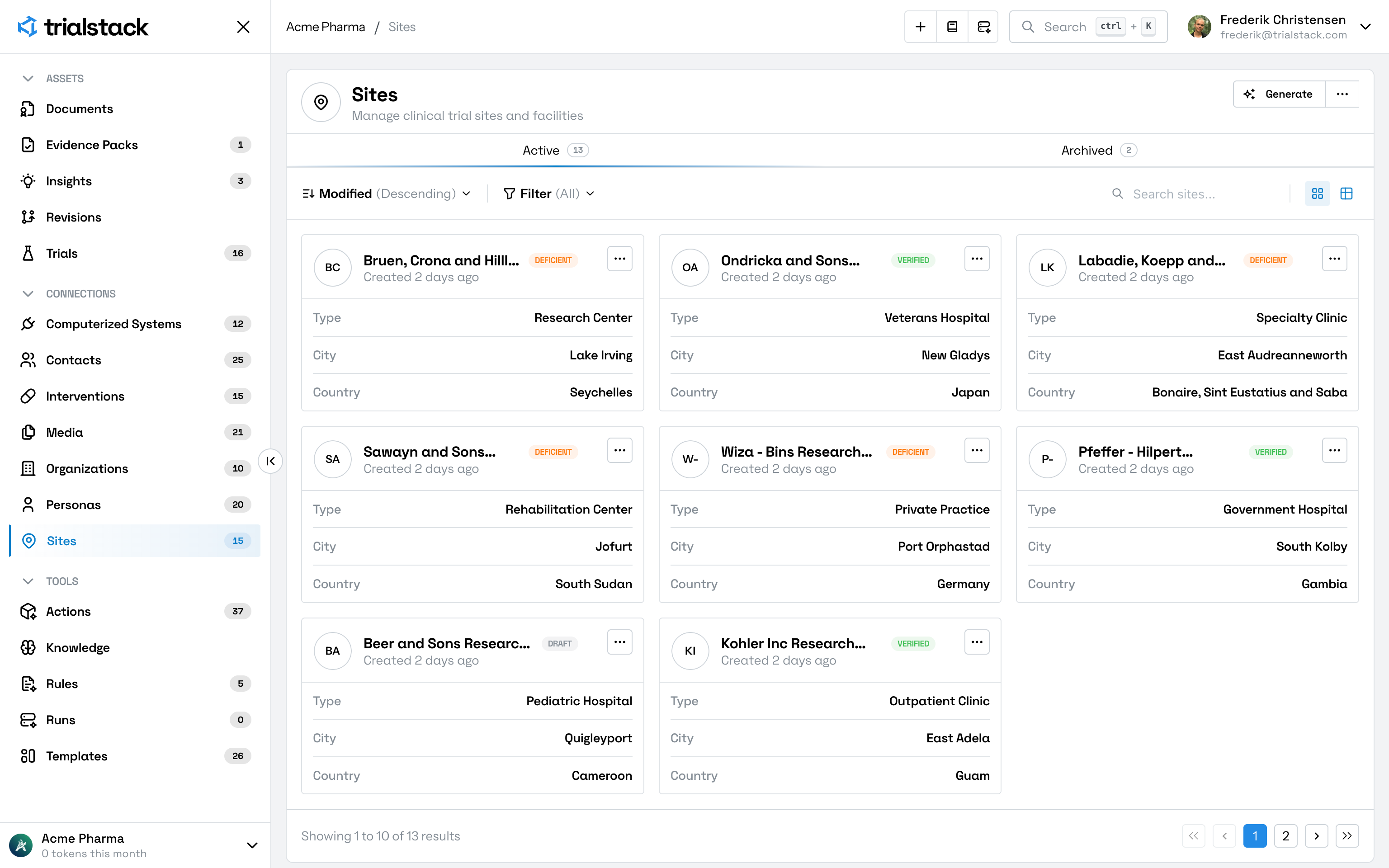
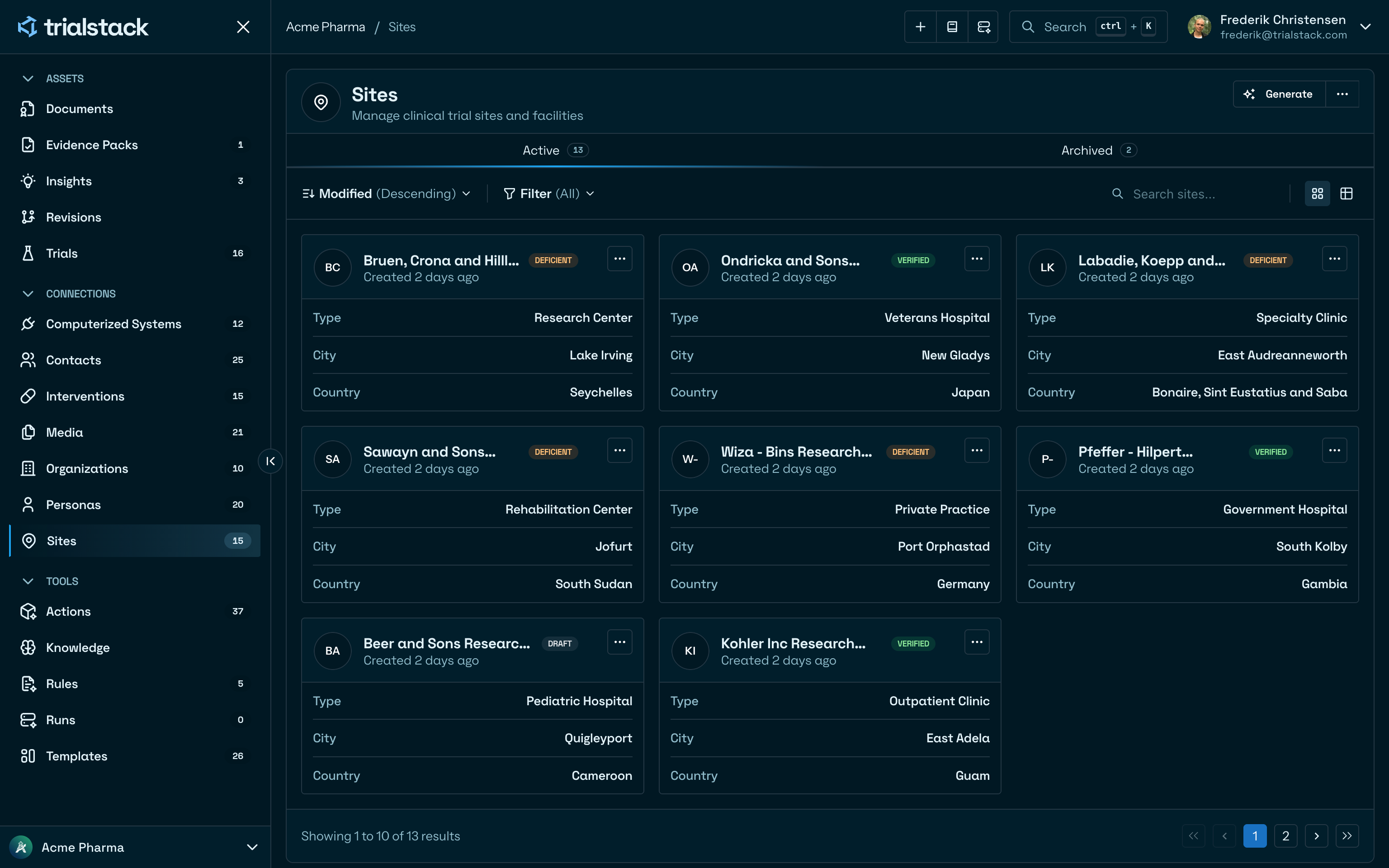
The sites list shows active and archived records, governed status, and the core location fields teams scan first.
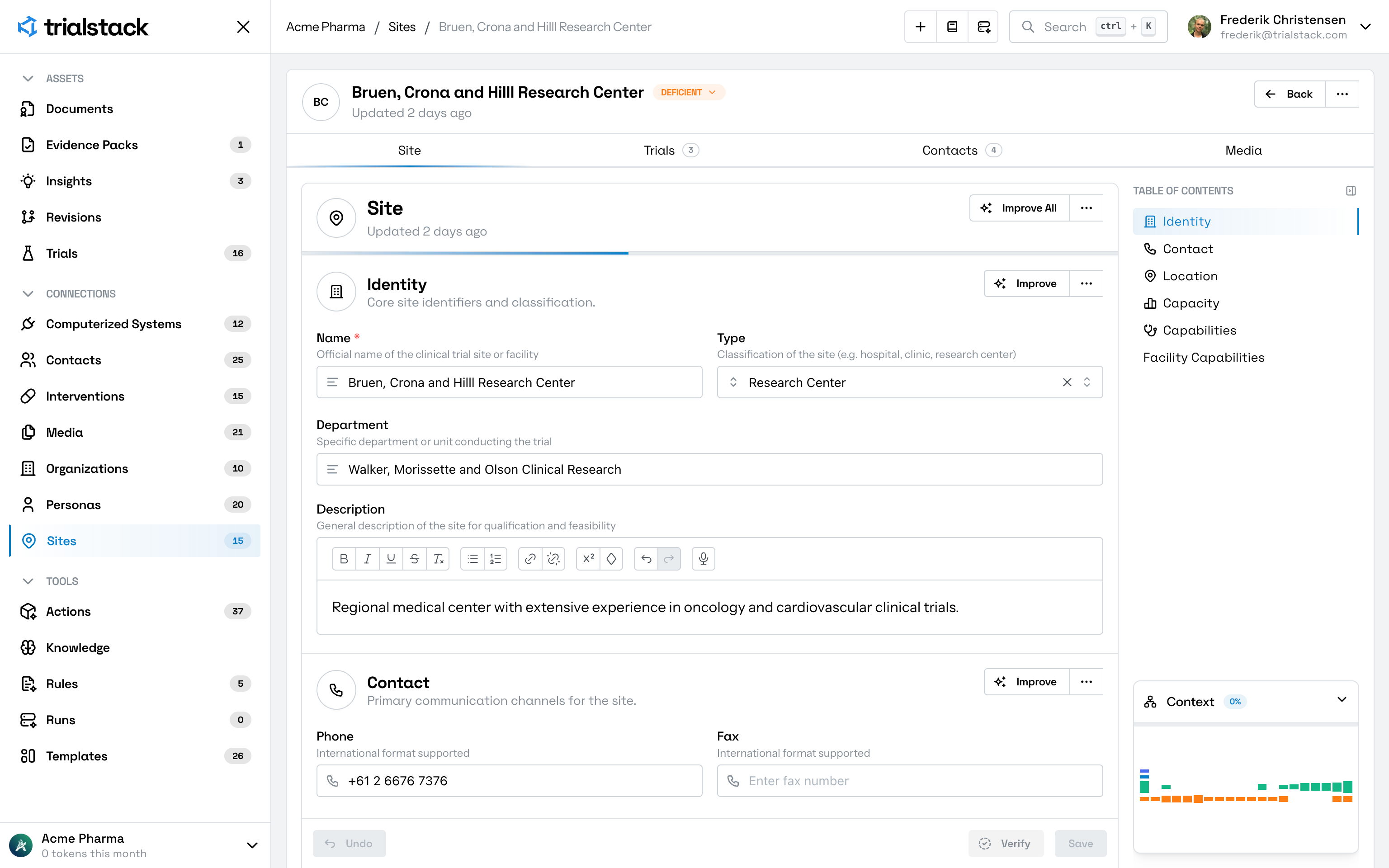
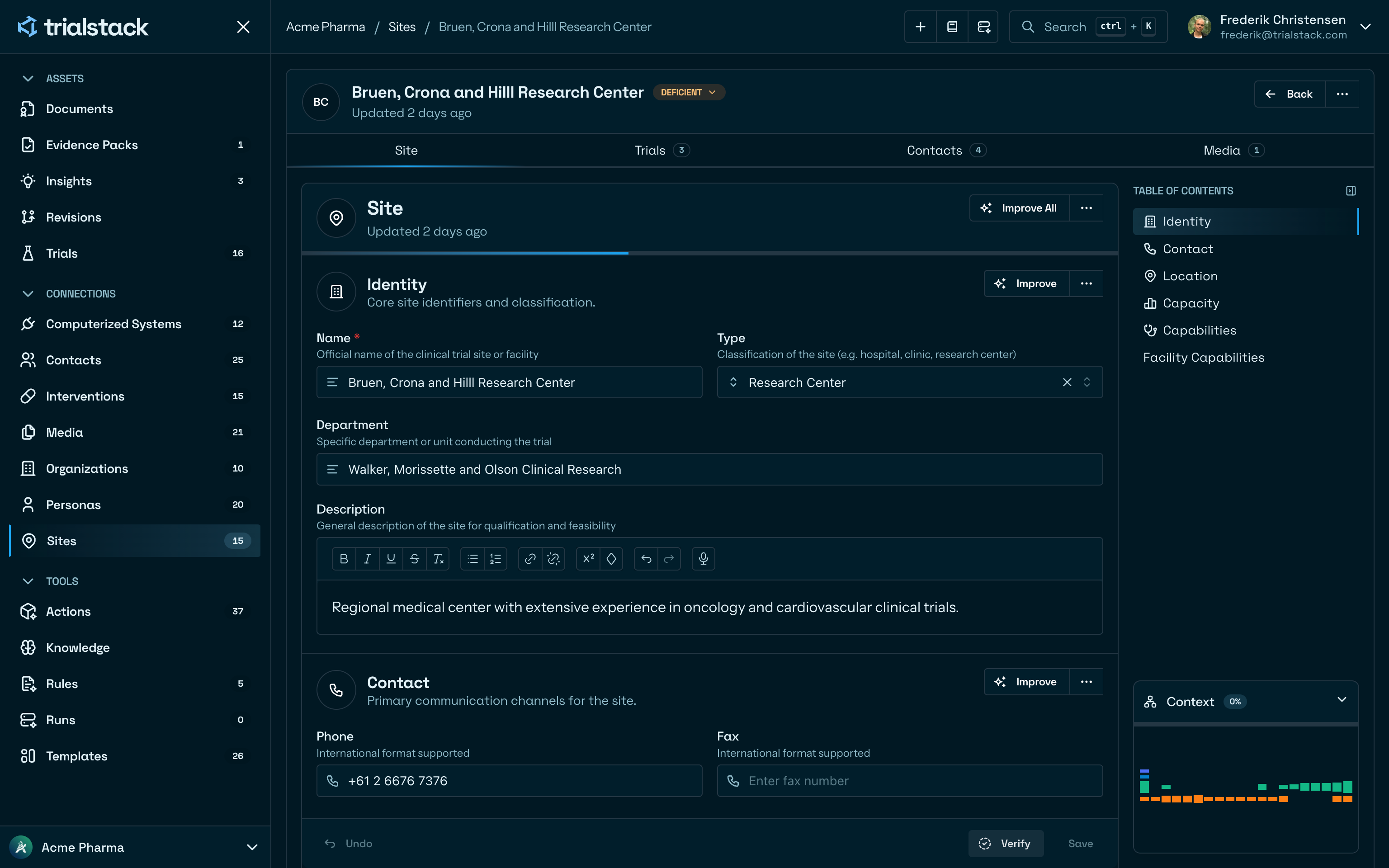
A site record combines the section-based summary surface with relationship tabs for trials, contacts, and media.
On the page
The site page is section-based. It is built around six sections that move from identity through contact, location, capacity, therapeutic capabilities, and a detailed facility capability grid.
| Surface | Purpose | What users do there |
|---|---|---|
| Summary | Maintain site identity and operational readiness | Capture name, type, contact, location, capacity, capabilities, facility flags |
| Relationship tabs | Keep operational context visible | Review linked trials, contacts, media |
classDiagram
    class SitePage {
        +Summary
        +RelationshipTabs
    }

    class Summary {
        +Identity
        +Contact
        +Location
        +Capacity
        +Capabilities
        +FacilityCapabilities
    }

    class RelationshipTabs {
        +Trials
        +Contacts
        +Media
    }

    SitePage *-- Summary
    SitePage *-- RelationshipTabs
What to capture
mindmap
  root((Strong site records))
    Clear site identity
    Reliable local contact
    Accurate physical location
    Visible capacity and enrollment
    Therapeutic and language scope
    Detailed facility readiness
A strong site record is not just a name and address under an organization. It makes clear whether the location is operationally ready for the work being linked to it.
Good site records usually do five things well:
- they establish a clear identity with type and department context
- they provide local contact details — phone, email, website — so coordination is never blocked
- they pin the location with full address and timezone for scheduling
- they show capacity and current enrollment so feasibility is visible
- they prove readiness through facility capability flags that reviewers can assess at a glance
That is why only Name is required. The point is to capture the operational context that supports real downstream decisions, not to force every flag into place upfront.
Identity
mindmap
  root((Identity))
    Name
    Site type
    Department
    Description
This section establishes what the site is and how it fits within its parent organization.
| Label | Description | Type |
|---|---|---|
| Name | Primary name of the site or operational unit | Text |
| Site Type | Classification such as hospital, clinic, lab, remote unit | Select |
| Department | Specific department or division within the site | Text |
| Description | Free-form description of the site, its context, and operational focus | Rich text |
Contact
mindmap
  root((Contact))
    Phone
    Fax
    Email
    Website
This section provides the local communication details needed for site-level coordination.
| Label | Description | Type |
|---|---|---|
| Phone | Primary site phone number | Phone |
| Fax | Fax number if applicable | Phone |
| Site-level email address | ||
| Website | Site website or portal | URL |
Location
mindmap
  root((Location))
    Address autocomplete
    Street and city
    State and postal code
    Country
    Timezone
This section locates the site physically. An address autocomplete field can populate the individual fields automatically.
| Label | Description | Type |
|---|---|---|
| Address Autocomplete | Type-ahead search that populates address fields from selected result | Address autocomplete |
| Address Line 1 | Primary street address | Text |
| Address Line 2 | Secondary address detail such as suite or floor | Text |
| City | City or municipality | Text |
| State / Province | State, province, or region | Text |
| Postal Code | ZIP or postal code | Text |
| Country | Country — searchable dropdown | Select |
| Timezone | IANA timezone for scheduling and coordination | Select |
Capacity
mindmap
  root((Capacity))
    Capacity target
    Current enrollment
This section shows the throughput context needed for feasibility decisions.
| Label | Description | Type |
|---|---|---|
| Capacity | Target participant capacity for the site | Number |
| Current Enrollment | Number of participants currently enrolled | Number |
Capabilities
mindmap
  root((Capabilities))
    Therapeutic areas
    Languages spoken
This section describes the therapeutic and language scope the site can support.
| Label | Description | Type |
|---|---|---|
| Therapeutic Areas | Disease or therapy categories the site supports | Multi-select |
| Languages Spoken | Languages available for participant interaction | Language multi-select |
Facility Capabilities
mindmap
  root((Facility Capabilities))
    Certifications
    Laboratory and Diagnostics
    Pharmacy and Storage
    Facility
    Data and Documents
    Patient Access
This section captures 23 operational readiness flags organized in six groups. Each flag is a toggle that indicates whether the site has the specific capability.
Certifications
| Label | Description | Type |
|---|---|---|
| Is Certified | Whether the site holds a relevant certification | Toggle |
Laboratory & Diagnostics
| Label | Description | Type |
|---|---|---|
| Has Lab | On-site laboratory capability | Toggle |
| Has Imaging | On-site imaging capability | Toggle |
| Has Pathology | On-site pathology services | Toggle |
| Has Genomics | On-site genomic testing capability | Toggle |
| Has Biobank | On-site biobank or specimen storage | Toggle |
| Has POC Testing | Point-of-care testing capability | Toggle |
Pharmacy & Storage
| Label | Description | Type |
|---|---|---|
| Has Pharmacy | On-site pharmacy | Toggle |
| Has Cold Storage | Temperature-controlled storage capability | Toggle |
| Has Controlled Substance Storage | Secure controlled substance storage | Toggle |
| Has Radiopharmacy | Radiopharmaceutical handling capability | Toggle |
| Has Compounding | On-site compounding capability | Toggle |
| Has IP Storage | Investigational product storage capability | Toggle |
Facility
| Label | Description | Type |
|---|---|---|
| Has Overnight | Overnight stay capability | Toggle |
| Has Infusion | Infusion suite or capability | Toggle |
| Has Emergency | Emergency response capability | Toggle |
| Has Telehealth | Telehealth or remote visit capability | Toggle |
| Has Accessibility | Accessibility accommodations | Toggle |
Data & Documents
| Label | Description | Type |
|---|---|---|
| Has EHR Integration | Electronic health record integration | Toggle |
| Has Monitoring Room | Dedicated monitoring room for study oversight | Toggle |
Patient Access
| Label | Description | Type |
|---|---|---|
| Has Transportation | Patient transportation support | Toggle |
| Has Parking | Designated patient parking | Toggle |
| Has Childcare | Childcare support for participants | Toggle |