The challenge asked a practical question: can a digital protocol remove manual work from configuring clinical data-acquisition systems?
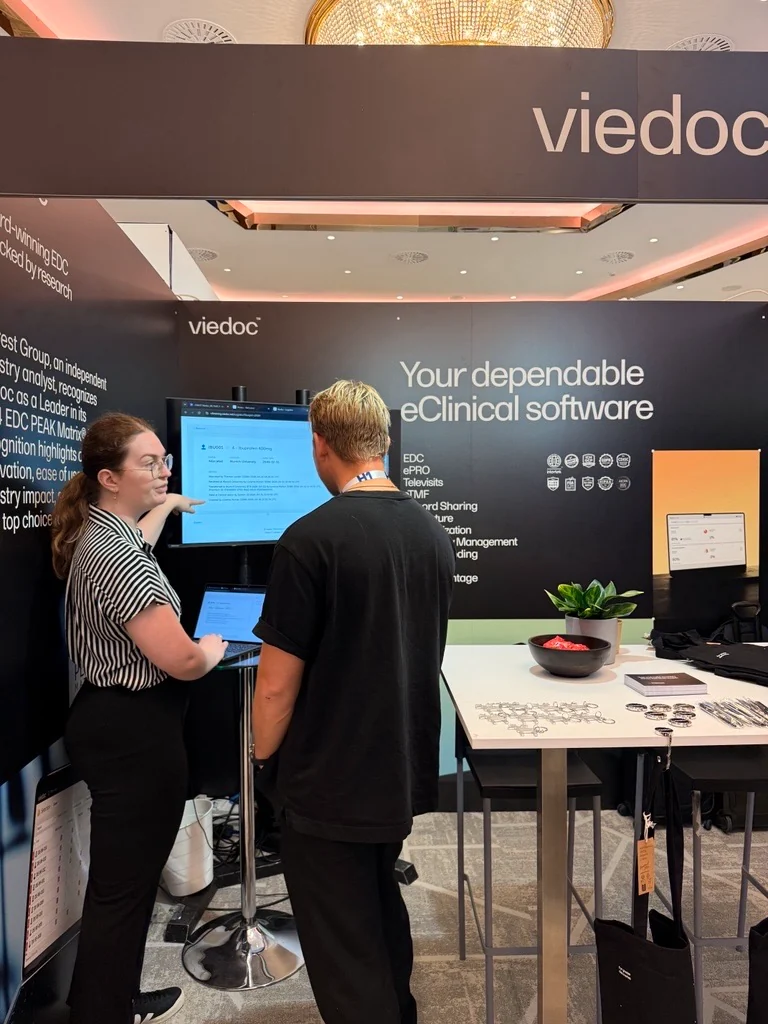
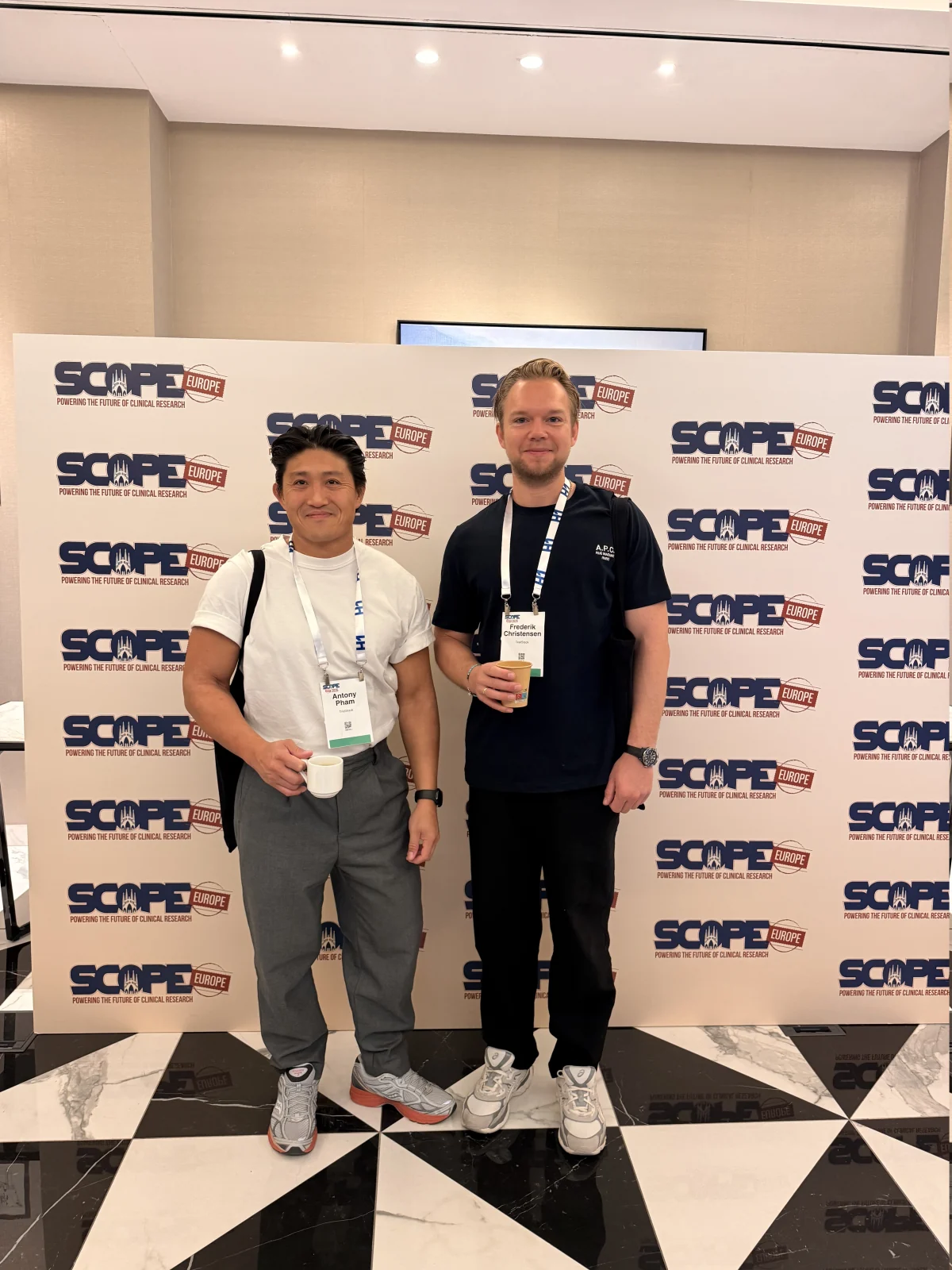
We travelled to SCOPE Europe in Barcelona with a clear position. AI could help a team create and review one governed trial definition. Each downstream configuration should then be deterministic.
Viedoc made that position testable. Their team created the sandbox, shared import guidance and templates, then reviewed the result with us. Viedoc later published the story so the wider clinical research community could examine the approach.
We started from Eli Lilly’s public Xanomeline protocol, H2Q-MC-LZZT(c), as a PDF rather than ready-made USDM. TrialStack Studio produced a governed definition containing 13 visits, 18 forms, 94 fields and 80 form placements. We imported a deterministic projection of that definition into the Viedoc sandbox.
A working import in three days
From sandbox access to the first working import, the collaboration spanned three working days. That window covered the complete integration loop across both teams. It included TrialStack generation, human review, CRF design, Viedoc-specific adjustments, sandbox import and joint inspection.
The retained timing record separates the work:
- 4 minutes and 24 seconds for the initial governed trial definition
- 7 minutes and 12 seconds for the schedule, visits and activities
- 11 minutes and 36 seconds combined system execution time
These timings isolate system execution inside TrialStack. The three-day result captures the end-to-end collaboration required to reach a reviewed Viedoc configuration.
AI helped before the export
AI helped interpret the protocol into a governed, versioned definition aligned with USDM. Rules constrained what it could propose. Each run retained its request, sources, output and findings.
The same workflow linked scheduled activities and Biomedical Concepts to forms with CDASH-aligned fields. That lineage records why each field is collected, not only how the form looks. CDISC’s open-source Data Definition Engine uses the same relationship between activities and Biomedical Concepts.
After review, the handoff stopped being generative. Deterministic code produced ODM 1.3.1 and SDM-XML 1.0. The model neither wrote XML nor invented Viedoc extensions. Viedoc imported a reproducible projection of the governed definition.
Review made the handoff better
The first import established the end-to-end handoff. Viedoc’s review then improved one target-specific decision. We had represented concomitant medications with a repeating group. Their team recommended Common Event because the items are coded at form level and repeating groups are limited to 50 entries.
This is what the collaboration was designed to expose. USDM preserved the common trial intent. Viedoc expertise shaped the target-specific projection without changing the underlying trial intent.
The result was a working, jointly reviewed sandbox proof of concept. Production validation, full edit-check coverage, live synchronization and complete round-trip evidence were outside the scope of the demonstration.

The same definition now carries further
The Viedoc proof established one EDC handoff. Recent implementation work carries the same governed definition further across the standards chain.
DDF Implementation Handbook 1 connects structured trial design to the SDTM Trial Design domains TA, TE, TV, TI and TS. USDM Implementation Handbook 2 expresses the Schedule of Activities as reusable USDM data. TrialStack now supports timing anchors, subtimelines, repeated cycles, branching, activity relationships and footnote conditions. Unsupported patterns remain explicit findings rather than guessed trial content.
The Schedule of Activities connects scheduled activities to accepted Biomedical Concepts and property references. Exact form versions and placements retain those source pins. This makes the path from trial activity to collection field reviewable.
From the same ODM export, TrialStack can produce blank and annotated CRF review packages. PDF receipts bind each field and annotation to the source export. Those pages can become exact origins in a Define-XML review package. Accepted field semantics can seed an SDTM mapping proposal, while an analysis specification pins the exact mapping version and source identities it expects.
TransCelerate’s Digital Study Design Use Case Library places this chain in a wider operating context: protocol authoring, trial build, amendments, SDTM domains, analysis and regulatory review.
This is the thread that connects the work to the CDISC 360i vision: trial design, collection, standards metadata and analysis remain traceable to the same governed decisions. A change to a visit, activity or measurement can be reviewed against the artefacts that depend on it.
External execution, participant-data processing and complete round-trip evidence remain separate gates.
The boundary is the point
The path from Barcelona to the Viedoc sandbox demonstrated a clear division of responsibility.
AI can help people interpret, author and review. Structured contracts can check the result. Deterministic code can produce a target handoff. People who understand the trial and the receiving system remain accountable for accepting it.
The EDC remains the operational data-capture system. TrialStack remains accountable for the governed definition and the projection it produces. That boundary is what lets one definition travel further without becoming several fast but inconsistent answers.
Viedoc’s openness allowed us to test that boundary in a real receiving system and share what we learned.
Explore the challenge through ClinEco, read Viedoc’s article or watch the complete workflow.